In this report
What we found
What does an AI citation actually prove?
A citation gives you a source to inspect. It does not, by itself, establish that the sentence beside it is accurate. For a business tracking AI visibility, that leaves an important second question after “Did our website appear?”: “Was our business described correctly?”
The practical problem is easy to miss. An answer might link to the right page and still leave out a condition that changes what you offer. Counting the link as visibility is reasonable. Counting it as verified, favorable coverage requires another check.
This review compares three studies that tested different parts of that problem. Their findings document failures in the systems sampled at the time; they do not establish a current error rate for every AI platform. We then propose an audit worksheet and work through a fictional service business. The worksheet is an editorial recommendation, not a validated scoring standard or an experiment we have run.
Our recommendation is to keep the visibility observation and the accuracy assessment side by side. Preserve a real citation even when the attached claim is wrong. Flag the misrepresentation separately so a higher citation count cannot quietly conceal a worsening description of your business.
Three studies, three different tests
| Study and collection period | What was tested | Reported finding | What the number does not mean |
|---|---|---|---|
| Tow Center, February 2025 1 | 1,600 excerpt-identification queries; eight tools; 200 articles from 20 publishers | More than 60% returned incorrect source identification | Not the share of all AI factual claims that are false |
| Liu, Zhang and Liang, February-March 2023 2 | Four engines; 1,450 queries each | Average citation recall: 51.5%; precision: 74.5% | Different denominators, not two estimates of one accuracy rate |
| EBU/BBC, May-June 2025 3 | 2,709 evaluated core news responses | 31% had significant sourcing issues; 45% had any significant issue | Response-level judgments, not percentages of individual links |
Tow graded the article, publisher and URL returned for supplied excerpts. It selected passages whose originals appeared in Google's top three results. This is a source-identification task. 1
Recall uses verification-worthy statements; precision uses generated citations. The latter credits certain partial sources that jointly establish a complete claim, so it does not mean each counted link independently supports the entire sentence. 2
The news study encouraged use of participating publishers and excluded refusals. Its BBC-only comparison suggested improvement, but used different response sets (362 versus 237) and changed products and methods. It was not a controlled comparison. 3
Do not average the three rows or present them as a league table. A retrieval test, a sentence-support assessment and an editorial response review ask different questions. A newer publication date also does not mean its responses were collected recently. For a purchasing decision today, ask for the tested task and collection dates before relying on a headline percentage.
Separate the checks before scoring the answer
For this worksheet, use four checks: link access, source identity, support for the specific claim, and coverage of important claims. Keep a separate note about whether the underlying business fact is true. That last distinction prevents two common mistakes in an internal review.
First, a true statement can have an unsuitable citation. Imagine an answer correctly says your service operates in Canada, but links to a page discussing only your US office. Your business records may confirm the Canadian service; the cited page still fails to establish it. The correct action could be improving a public service-area page, rather than challenging a true claim.
Second, an answer can faithfully repeat an obsolete page. Suppose that page still lists an integration you discontinued. The source supports the wording, but the business information needs correction. Give the page owner a concrete update instead of recording a vague “AI hallucination” ticket.
OpenAI's current guidance explicitly warns that citations can be incomplete, outdated or incorrect. Its Sources view may also contain other relevant links, so a panel entry is not necessarily a citation attached to the sentence you are reviewing. 4
Choose the unit before you count. Our worksheet uses one row per checkable claim in an answer and lists all its attached sources together. If a sentence contains two independent business claims, split it into two rows. This lets a reviewer identify exactly which statement is supported without giving an entire paragraph a pass because one detail is correct.
Capture enough evidence for someone else to check
Download the blank citation-audit worksheet (CSV). It contains field names, not invented findings. Make a copy for your team and keep completed records private if the captured conversation includes confidential information.
Start with questions that matter to a customer choosing your service. Record why you selected them. A list chosen because it already produces troubling answers is useful for repairs, but it cannot estimate how often an ordinary customer encounters a problem. Keep that repair sample separate from any recurring monitoring set.
Save the exact prompt and complete answer, not just a screenshot of your company name. Record the collection time, language, location setting when known, product surface, visible model label, and search setting. Leave unavailable details blank and note that they were unavailable. Do not guess the underlying model from the application's name.
For each claim, copy its attached citation URLs and identify the exact passage that appears to support it. Keep relevant qualifications with that passage: a date, an eligibility condition or a geographic restriction can change the meaning. Record when you opened the source because its contents may change after the answer was saved.
A second reviewer should be able to follow the row from claim to URL to passage and understand the decision. If they cannot, improve the record before arguing about the score. You do not need to copy a whole source page into a shared spreadsheet; a short necessary excerpt, location and check date will often make the decision reviewable.
Finally, assign the record an owner and a next action. An audit with no route to a correction is another dashboard to maintain.
Make the support decision explicit
Use these proposed labels consistently. They describe your assessment of the cited material, not the platform as a whole.
| Label | Decision rule for this worksheet | What to record |
|---|---|---|
| Fully supported | The available attached sources establish the complete claim, including its conditions | Relevant passages and qualifications |
| Partly supported | They establish some of it, but leave a material part unestablished | The exact unsupported part |
| Unsupported | The accessible material does not establish the claim | What was checked and what is missing |
| Contradicted | The source explicitly conflicts with the claim | Both statements and their dates |
| Unassessable | Required source material cannot be inspected | Access problem and attempted check |
| Uncited | No source is attached to this claim | The claim and its place in the answer |
Several sources may jointly establish a claim. Note that explicitly rather than demanding that one page contain everything. Conversely, a source discussing the same topic does not establish a more specific promise about your company.
If a link fails, keep the original URL and any redirect destination. A paywall, login requirement or temporary error means you could not assess the material through that route; it does not prove the claim false or the source fabricated. An alternative page can help check the underlying fact, but should not silently replace the citation in the saved record.
For disputed labels, ask a colleague to review the claim without seeing your verdict first. Record the disagreement and the reason for the final decision. A difficult case is more useful as an explained exception than a forced pass that makes the report look tidier.
Worked example: a condition becomes a promise
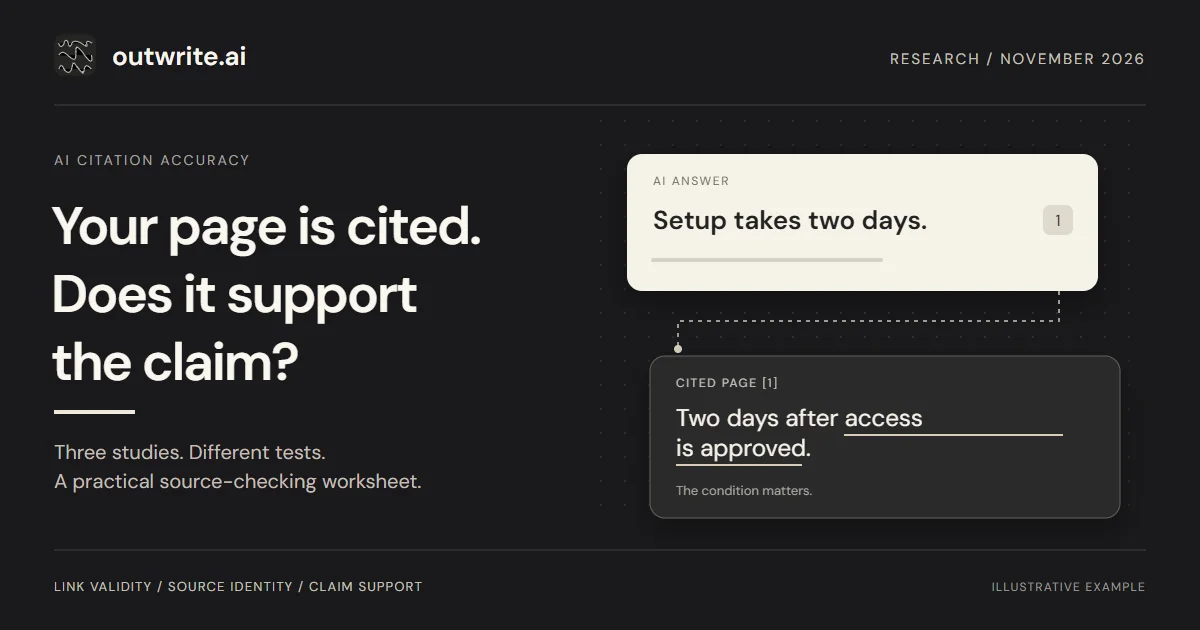
Consider a fictional IT onboarding service, Northline Setup. Its public page says that setup takes two business days after access has been approved. An AI answer instead says, “Northline Setup completes setup in two days,” with a link to that page. This is an illustrative example, not a customer incident or a measured model output.
The page opens and the publisher matches. Those checks pass. The support assessment does not: the answer drops the access requirement and changes business days to days. A buyer reading it on Friday could come away with a different expectation from the one the company publishes.
Record both omissions. Do not merely write “wrong timing.” The more precise ticket tells the person responsible what to inspect and prevents a cosmetic edit from closing the issue. The saved citation remains a genuine visibility observation, while the claim is flagged as partly supported and potentially misleading.
Next, inspect the page itself. If its headline promises two days and the condition appears much lower down, revising that presentation is a sensible editorial action. Put the qualification beside the promise and check other public pages for conflicting wording. If the existing page is already clear, rewriting it repeatedly may be wasted effort. Keep the accurate wording and document the faulty summary through the relevant product's feedback process where available.
After any page edit, confirm that the published text matches the intended service terms. Then sample the original question again and save the new answer as a separate observation. Do not overwrite the earlier record. One corrected answer shows what happened in that check; it neither proves your edit caused the change nor promises that every future answer will include the condition.
Report the denominator, including what you could not assess
For a small operational review, counts can be clearer than a single percentage. Keep these fields separate:
- Total checkable claims reviewed.
- Claims with at least one attached citation.
- Cited claims whose source set could be assessed.
- Assessed claims fully supported by that source set.
- Partly supported, unsupported and contradicted claims.
- Unassessable and uncited claims.
A hypothetical review might contain 20 claims, of which 16 have citations. If two cited source sets cannot be assessed, 14 remain assessable. Suppose ten are fully supported, two partly supported and two unsupported. Report citation presence as 16/20, assessed support as 10/14, and list the two unassessable and four uncited claims alongside those counts. These numbers are invented solely to explain the worksheet.
The conditional 10/14 result says nothing about the truth of the six claims outside that denominator. Nor is it the same metric as the studies above: this worksheet uses your selected business claims and its own review rules. Do not attach a benchmark label to it.
Keep missing answers, technical collection failures and refusals in a separate run log. They produced no assessable answer in that run, so they should not become fabricated negative brand mentions. For repeated monitoring, preserve the question set and record changes to it. If you add difficult questions halfway through, explain that change before interpreting a lower support rate.
Use the counts to choose work. A few misstatements about eligibility may deserve attention before many harmless omissions. The business consequence of the claim matters alongside its frequency.
Choose a correction you can verify
Give each issue an owner based on what can actually be changed.
An inaccurate page you own: send the content owner the disputed statement, correct information and affected URLs. Close the content task only after checking the live page. Keep the later AI-answer check as a separate task with its own outcome.
An accurate page represented incorrectly: preserve the answer, source and passage. Use an available platform reporting route with a concise explanation. Record whether a report was submitted, but do not mark the answer corrected just because the submission succeeded.
An inaccurate third-party source: request a correction from that publisher if appropriate. Supply a public reference for the fact, and keep your own pages consistent. You cannot promise that another publisher or search product will act on the request.
A source-access problem: investigate the URL, redirects and intended access policy. Avoid weakening authentication or opening private material just to make an audit row pass. If the page should remain private, keep the assessment unassessable through the public route.
A useful handoff includes the exact claim, why it matters to a buyer, the evidence, the proposed change and how someone will verify it. That is enough to turn a visibility observation into a manageable editorial task. It also gives the next reviewer a history when the same description appears again.
What this review cannot establish
This report contains no new platform benchmark. The reviewed studies use historical products, selected questions and different assessment rules. News attribution and news-answer evaluation are not direct substitutes for tests of your own service pages. The current product guidance reviewed here concerns ChatGPT; it does not establish other platforms' interface behavior or a universal success rate.
The proposed worksheet is deliberately narrower than a platform comparison. It helps a team examine saved answers and correct specific public facts. Its labels still require human judgment; a spreadsheet cannot settle every ambiguous passage. A source may change or become inaccessible, and a later answer may differ for reasons unrelated to your edits.
If your main question is whether citations recur, use the separate AI visibility tracking reliability review. If you need to distinguish training, search and conversation context, start with where ChatGPT gets its information. Neither a citation count nor a support audit measures revenue. Keep any attribution or customer-outcome analysis separate.
For the next review, return to unresolved, commercially important claims first. Ask whether the underlying page is now accurate, whether a fresh answer represents it correctly, and what remains unknown. Those are useful outcomes even when no aggregate visibility score moves.
Methodology & limitations
Reviewed the original Tow Center article, the EMNLP paper, the EBU/BBC report and current OpenAI guidance on November 18, 2026. AI-assisted discovery used three recorded requests; one truncated response was excluded from evidence. Original sources were inspected directly, including study methods and denominators. AI-assisted synthesis was followed by a separate review and manual editorial checks. The audit worksheet, service example and counting example are editorial proposals, not original observations. No new benchmark of AI answer accuracy was conducted. A candidate paper about source provenance was excluded because it did not measure the claim-support question. Source review is due December 18, 2026; revisit earlier if the cited guidance changes.
outwrite.ai sells content research, writing, publishing and search-visibility software. This review does not establish that its use improves citation accuracy or guarantees rankings, recommendations or traffic.
Download the source and evidence notes (JSON) ↓Sources
- [1]AI Search Has a Citation Problem ↗
Tow Center / Columbia Journalism Review · March 6, 2025 · Checked 2026-11-18
Selected news excerpts; source identification, not general answer accuracy or current product performance.
↑ Back to findings - [2]Evaluating Verifiability in Generative Search Engines ↗
Liu, Zhang and Liang / Findings of EMNLP · December 2023 · Checked 2026-11-18
Historical systems; special joint-support precision rules; not a current accuracy estimate.
↑ Back to findings - [3]News Integrity in AI Assistants ↗
European Broadcasting Union / BBC · October 2025 · Checked 2026-11-18
Publisher-source prompting; refusals excluded; BBC-only comparisons changed products and some methods.
↑ Back to findings - [4]Searching the web with ChatGPT ↗
OpenAI Help Center · Living documentation · Checked 2026-11-18
Guidance supplies no measured error rate or guarantee of claim support.
↑ Back to findings
Report history
- : Initial evidence review with a proposed citation-audit worksheet. No original platform measurements.