In this report
What we found
- Our reading: domain-wide correlation and page-level overlap measure different things. Their values should not be compared as one score. [2][3][4]
- AI citations and brand recommendations need separate measurement. A named business need not have a linked page. [5]
- Pew measured clicks, not sales. Its findings do not establish a citation-to-customer conversion rate. [6]
Ahrefs, March 2026. Organic blue links only, matched to the same query. This is a distribution of cited URLs, not a page’s probability of citation. [2]
| Organic position | Share of cited URLs |
|---|---|
| Top 10 | 37.1% |
| Positions 11-100 | 26.2% |
| Outside top 100 | 36.7% |
Does Google rank predict AI visibility?
A Google ranking tells you where a page appeared in a search result. It does not, by itself, tell you whether an AI answer recommended your business. To find that out, you need to inspect the answer.
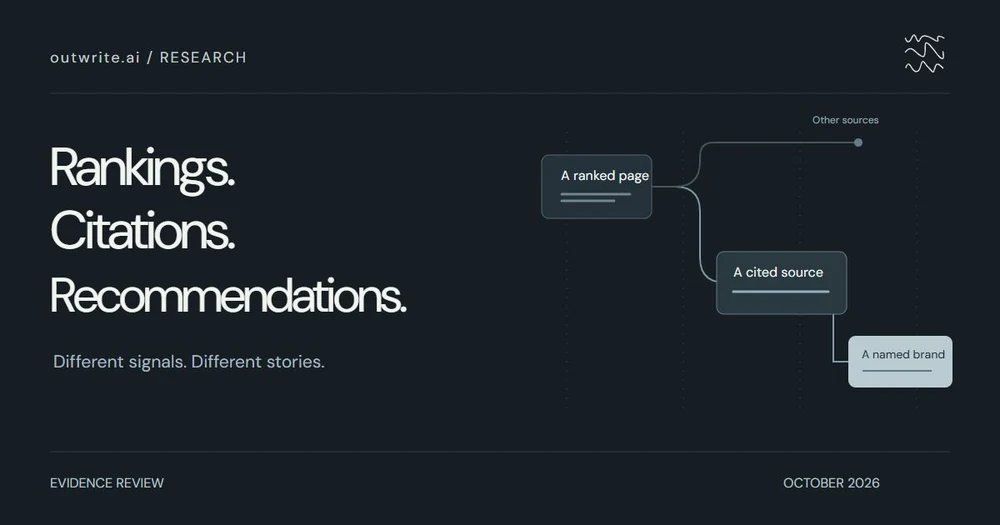
The problem starts when four different questions get compressed into one: does Google ranking predict an AI citation, does the answer recommend your business, does anyone visit, and does that visit become a customer?
We reviewed eight primary sources spanning vendor analyses, an academic preprint and platform documentation. They offer useful evidence, but they do not provide one universal conversion rate from Google position to AI visibility.
Our contribution is a comparison of their measurement methods and a practical way to act on them. We did not conduct the underlying studies. The strongest conclusion is to maintain an organic search strategy while measuring AI recommendations separately. A ranking report cannot substitute for reading what an answer actually says about your business.
Four measurements, four different answers
Start by deciding what you want to know. "Are we visible?" is too broad to produce a useful report.
| Measurement | What to record | What it does not establish |
|---|---|---|
| Organic position | A particular page's rank for a specified query, location and date | Whether an AI answer selected it |
| Source citation | A linked page or clearly attributed source in the answer | Whether the business was recommended |
| Brand recommendation | The business being suggested for the user's need, with surrounding context | Whether the reader visited or bought |
| Business outcome | A visit, qualified inquiry, booking or sale under a stated attribution method | Which unseen answer influenced the person |
This distinction changes the work you prioritize. If a page is repeatedly cited for a definition but the business is absent from buying recommendations, another definition article may not address the problem. If people visit a comparison page but never inquire, more citations may not fix the offer or the page.
A mention also needs interpretation. "Company A is not suitable for this requirement" contains the brand name, but counting it as a favorable recommendation would mislead the owner. Keep the actual answer excerpt alongside any label. Treat ambiguous cases as ambiguous rather than forcing a positive result.
What the published research measured
The evidence below is grouped by its unit of analysis. Publication dates identify the write-ups; where collection dates are not supplied, we have not guessed them.
| Source | Scope | Reported finding | Reading limit |
|---|---|---|---|
| Ahrefs, July 2025 1 | 1 million keywords, 1.9 million links; top three citations per AI Overview | Spearman correlation of 0.347 between top-10 rank and top-three citation inclusion | Selected citations, observational association |
| Ahrefs, March 2026 2 | 863,000 SERPs and about 4 million AI Overview URLs | See the organic-only chart near the start of this report | Expanded parsing prevents a simple historical comparison |
| Semrush, undated 3 | Top 10,000 domains in its AI Visibility Index | Keyword footprint and citation count correlated at 0.86 to 0.87 | Domains already selected for visibility, not individual page odds |
| Ahrefs, August 2025 4 | 118,931 ChatGPT fan-out queries | 6.82% of returned results overlapped Google's top 10 for the same sub-query | Retrieved results, not final endorsements |
| Chen and Koudas, October 2026 5 | 158,099 answers and 468,037 citations across two 90-day collections | Brand naming and source retrieval could occur through different mechanisms | Preprint; US English commercial questions and API replay limits |
| Pew Research Center, July 2025 6 | 900 US adults; 68,879 unique Google searches | Traditional-link clicks: 8% of visits with summaries, 15% without; summary-source clicks: 1% of visits with a summary | March browsing, April result reconstruction; no sales measurement |
These figures should not become a league table. A correlation coefficient is not a citation percentage. A share of retrieved URLs is not a share of recommended brands. Nor does a larger dataset automatically make its answer more relevant to your company: relevance depends on what was sampled and what was counted.
The denominator changes the story
Consider two questions:
- Of the pages an AI answer cited, how many ranked in Google's top 10?
- Of all the pages ranking in Google's top 10, how many did the AI answer cite?
They sound similar. They require different denominators.
A hypothetical example: imagine a collected set containing 100 cited URLs, with 40 also present in a separate set of 1,000 top-10 URL observations. The overlap is 40% of the cited set but only 4% of the ranked set. Both calculations are correct for this invented dataset. Neither means a business has a 40% chance of being recommended.
Real studies require consistent matching rules too. Would two URLs on the same domain count as the same source? Are tracking parameters removed? Does a video result count as an ordinary ranking? Does the query refer to the user's original question or a related search generated by the system?
Ask those questions before using a headline statistic in a strategy meeting. The useful formula is simple: count of the relevant outcome divided by the eligible observations, under the same matching rules. Write out both parts in words. If the denominator is unavailable, preserve that uncertainty instead of filling it in.
Domain-wide correlations raise another issue. A website can have broad coverage across a category while one of its pages performs poorly for a particular buying question. A relationship among whole websites does not tell you what will happen to that one page after an edit. It also does not tell you whether a small company should reproduce a large publisher's volume of content.
Changing methods can look like changing behavior
Ahrefs explicitly says it improved citation parsing before its March 2026 update. Its broad result-block count and its organic-only count also differ. That means a neat historical chart would risk attributing a measurement change entirely to search behavior. 2
For your own tracking, preserve the measurement definition as carefully as the number. Suppose a report begins counting links hidden behind an expanded source panel. A sudden increase in citations may reflect the new collector, not a newly successful content strategy. The same applies when you add more prompts, change countries or include a different AI product.
Use a stable comparison set and a separate discovery set. The stable set helps answer "Are we making progress on the same customer needs?" The discovery set helps answer "What are we missing?" New findings can enter the stable set later, with the change recorded.
Do not freeze the entire strategy to protect a tidy graph. Record the old and new definitions, keep comparable observations where possible, and annotate the transition. An imperfect but honest series is more useful than a smooth one that hides changing rules.
This is also why an answer collected through an API should be labeled as an API observation. It should not be presented as a verified screenshot of what every customer sees in the corresponding consumer app.
A citation is not a recommendation or a visit
Chen and Koudas observed brand naming without a supporting cited page. Their paper is a preprint with constrained markets and collection methods, not proof of a universal mechanism. It nevertheless gives a concrete reason to inspect the answer text separately from its sources. 5
Pew's click findings concern visits to search pages, not a per-citation click rate. The study reconstructed results after the browsing period and collected only the first three summary source URLs. It did not measure conversions. 6
For a business owner, we recommend separate reporting columns: mentioned, recommended, cited, visited and converted. A row can have more than one positive value, or none. Keep the answer and observation date so someone can inspect the classification.
This avoids an easy reporting mistake. A research page might support an answer about an industry, while the answer recommends a competitor's product. The citation is real and potentially useful, but describing it as a recommendation would conceal the commercial gap.
There is an attribution gap in the other direction too. If a prospective buyer says they found you through an AI assistant but later visited directly, the first session's referrer will not necessarily explain that journey. Record the customer's answer as self-reported attribution, alongside measured analytics. Neither should silently overwrite the other.
What to do with the evidence
Use this decision table to turn a visibility observation into a specific investigation. These are our editorial recommendations, not experimentally proven ranking interventions.
| What you observe | What to investigate | A useful next action |
|---|---|---|
| A page ranks, but is rarely cited | Whether it actually answers the tracked question and its constraints | Compare the answer's chosen sources with the page's substance |
| Your page is cited, but your business is not recommended | Whether the cited material supports a buying decision or only a general fact | Clarify genuine use cases, suitability, limitations and evidence |
| Competitors are named for a recurring need | Whether the need fits your offer and whether you have credible material on it | Fill a real information gap, without unsupported competitor claims |
| Recommendations appear, but visits remain weak | Whether the prompt is commercially relevant and whether links are provided | Check actual referrals and downstream inquiries before adding more content |
| Visits arrive, but inquiries do not | Whether the page, offer and next step match visitor intent | Improve the decision and conversion experience before chasing more visibility |
A hypothetical software example: a documentation tool gets cited for explaining versioned documentation. It rarely appears when someone asks which tool suits a small team migrating from a wiki. The next useful page may be an honest migration comparison with requirements, limitations and examples. Publishing three more definitions of documentation would not directly address that decision.
A hypothetical local-service example: a company appears in recommendations outside its service area. Counting every mention as success would reward the wrong audience. The useful work is to make its actual coverage and offer clear and measure questions from the market it can serve.
Start with the customer's decision, then determine the missing evidence. That may justify a new article, an improvement to an existing page, or no new content at all. Never manufacture experience, credentials or customer results to make a page look more convincing.
A practical measurement plan
Google says ordinary SEO foundations remain relevant to its AI features and that those features can issue related searches. It includes AI-feature traffic in Search Console's Web reporting. That does not turn the aggregate report into a complete inventory of AI recommendations. 7
Microsoft's AI Performance preview offers intent, topic, citation-share and comparison information across its covered experiences. Use it for those surfaces rather than extrapolating to every assistant. 8
For a manageable starting point, build a small measurement sheet with these fields:
- Customer need: the decision or problem, with country and language.
- Prompt: the wording, intent and whether it belongs to the stable or discovery set.
- Observation: date, product, interface, relevant settings and saved answer.
- Answer assessment: brand named, recommendation context and linked source URLs.
- Website evidence: relevant page, organic queries, clicks and impressions.
- Business evidence: qualified forms, bookings or sales under your chosen attribution rules.
- Action and review date: what changed and when you will examine the outcome.
Do not ask one score to summarize all of this. A concise summary can still show separate trends for recommendations, source coverage and site outcomes. The supporting rows make those trends auditable.
Set a review rhythm you can sustain. Compare the same prompt cohort over time, then investigate the repeated gaps. If you change the prompt set, preserve its version. If the data is sparse, describe the observation rather than inventing a trend. A handful of answers can suggest a question worth investigating; it cannot establish market share.
For content planning, attach a short hypothesis to each action: "This page should answer the migration requirements missing from our current coverage." Later, evaluate that hypothesis against the saved answers and relevant search queries. If the intended need is still not addressed, revise the hypothesis before ordering another similar article.
The purpose is to learn which information customers need and whether your site supplies it. More pages and more tracked prompts are only useful when they improve that understanding.
What this review cannot tell you
We cannot calculate the probability that your next article will be cited, identify a universal content length that earns recommendations, or promise a return from a particular publishing schedule. The studies here do not establish those outcomes.
Several write-ups omit their collection window. Most empirical sources in this review come from companies selling search measurement tools; their work can be informative without being representative of every business. The academic source is a preprint, and its findings have their own sampling and replay limitations.
We have not pooled the studies, reproduced their datasets or measured the effect of outwrite.ai. Nor does the absence of an experiment in this selection mean no relevant experiment exists elsewhere. This is a focused review of the cited material, checked on the date shown.
The decision we would make from it is practical: keep building useful, discoverable content, but inspect AI answers directly before assuming a ranking has become a recommendation. Then check whether the visibility connects to the customers you actually want. That gives you a clearer basis for your next article than a borrowed industry percentage.
Methodology & limitations
We selected primary empirical work comparing organic visibility, AI source selection, brand naming and clicks, plus official measurement guidance. We checked the original write-ups and the preprint’s methods and limitations. The comparison separates platform, unit, denominator, sample and measurement period. We did not combine study estimates or collect a new answer dataset. The chart reproduces the cited organic-only percentages; the worked denominator example is hypothetical. This is a focused editorial review, not a systematic review or meta-analysis.
outwrite.ai sells content automation and AI visibility software. This report uses AI-assisted source discovery, drafting and editorial checks, with the cited findings checked against their original sources. It does not test our product or establish that using it causes ranking, citation or revenue gains.
Download the source and evidence notes (JSON) ↓Sources
- [1]Does Ranking Higher on Google Mean You'll Get Cited in AI Overviews? ↗
Ahrefs / Si Quan Ong · July 21, 2025 · Checked 2026-10-26
Observational vendor study; selected citations, not all links or recommendations.
↑ Back to findings - [2]Update: 38% of AI Overview Citations Pull From The Top 10 ↗
Ahrefs / Louise Linehan · March 2, 2026 · Checked 2026-10-26
The authors describe improved citation parsing; not a controlled before-and-after comparison.
↑ Back to findings - [3]SEO is foundational for AI search visibility: Our data shows how ↗
Semrush · Undated; checked October 26, 2026 · Checked 2026-10-26
Selected already-visible domains; domain-level correlation, not page-level probability or causation.
↑ Back to findings - [4]Is ChatGPT Really Powered by Google? 118,931 Fan-Out Queries Analyzed ↗
Ahrefs / Si Quan Ong · August 20, 2025 · Checked 2026-10-26
Retrieved results are not final citations or endorsements; a historical vendor sample.
↑ Back to findings - [5]What Drives AI Citations? Content, Retrieval and Model Knowledge in Generative Engine Optimization ↗
Mahe Chen and Nick Koudas / arXiv v1 · October 10, 2026 · Checked 2026-10-26
Preprint; English US commercial prompts, API replay limitations and about one-third of cited URLs unavailable for page analysis.
↑ Back to findings - [6]Google users are less likely to click on links when an AI summary appears in the results ↗
Pew Research Center / Athena Chapekis and Anna Lieb · July 22, 2025 · Checked 2026-10-26
Observational; search results reconstructed later; only first three summary source URLs collected. No conversion measurement.
↑ Back to findings - [7]AI features and your website ↗
Google Search Central · Living documentation · Checked 2026-10-26
Platform guidance does not establish a citation or conversion probability.
↑ Back to findings - [8]New AI Visibility Insights in Bing Webmaster Tools: Intents, Topics, Citation Share, Compare ↗
Microsoft Bing · June 16, 2026 · Checked 2026-10-26
Microsoft's covered surfaces; not a measure of all AI systems, visits or sales.
↑ Back to findings
Report history
- : First publication. Source methods and limitations checked; no original measurement claimed.