In this report
What we found
- Our interpretation: these different populations, outcomes and comparison channels cannot form one universal conversion benchmark. [1][2][3][4]
- Event counts and converting sessions are different measures. Keep the outcome definition next to the rate. [6]
- Google AI features are included in organic search reporting, rather than the separate AI Assistant channel. [5][8]
Does AI referral traffic convert better?
Our reading of these reports is that some sites do, but there is no reliable universal multiplier to put in a small business forecast. The studies below describe particular sites, events and periods. A higher conversion rate can coexist with fewer customers, and an AI referral report cannot show every way an AI answer influenced a buyer.
The useful question is whether the people reaching your business are doing something worthwhile, and whether you can connect that action to a source. This review compares primary evidence and proposes a practical way to answer that question. We did not run the underlying studies. Our worked example is fictional, and our measurement recommendations are editorial judgments.
What four studies actually measured
Keep the comparison column attached to the result. These figures cannot be averaged into an industry benchmark.
| Source | Population and period | Reported result | What limits the comparison |
|---|---|---|---|
| The SEO Works 1 | 95 websites, September 2025 to August 2026; 63 eligible conversion properties | Pooled key events per session: AI 7.18%; organic 6.08%; AI was lower on 23 sites | Selected sites; not unique customers; Google AI features fall within organic |
| Ahrefs 2 | Its own site, the prior 30 days in a June 2025 report | AI signup rate per visit was reported as 23 times organic | Single-company funnel; totals and exact dates not supplied; signups are not payments |
| Marie Haynes 3 | 100 sites, over 145 million sessions across 12 months; 55 of the 100 sites tracked conversions | ChatGPT: 13.8%; Google organic: 3.02%; Google organic delivered 27 times the conversions of all LLMs combined | Exact dates, event definitions and weighting not fully specified |
| Adobe 4 | U.S. retail and travel cohorts, July 2026 | AI purchase conversion was 60% higher in retail and 1% lower in travel relative to non-AI traffic | Non-AI includes channels beyond organic; exact site counts not given |
These are reported observations, not controlled estimates of what would happen if the same person arrived through a different channel. The source notes below preserve further methodological details and links to the originals.
Before comparing rates, define the outcome
A completed purchase, an account registration and a request for a quote answer different business questions. Calling each a conversion does not make them equal. Start with the decision you need to make: whether an article attracts potential buyers, whether a trial is useful, or whether a channel produces paying customers.
For a service company, a submitted enquiry might be the first measurable step. The next question is whether that enquiry fits the service, location and budget. A form that attracts unrelated requests can produce an impressive rate without producing work the business can accept.
For software, separate registration from activation and payment. A customer may open an account to explore a feature and never finish setup. That first action still matters, but it should not be presented as recurring revenue. Decide which event is the primary outcome and retain the others as separate steps.
Google Analytics also distinguishes event occurrences from sessions containing an event. Its session key event rate uses the latter. 6 An event total divided by sessions can therefore answer a different question from the percentage of sessions that converted. Select the same definition for both channels before comparing them.
Our recommendation is to write the definition beside the number, rather than leave it in a forgotten dashboard note. “Completed booking sessions” tells an owner more than “conversions.” It also makes accidental tracking changes easier to spot.
A higher rate can still produce less business
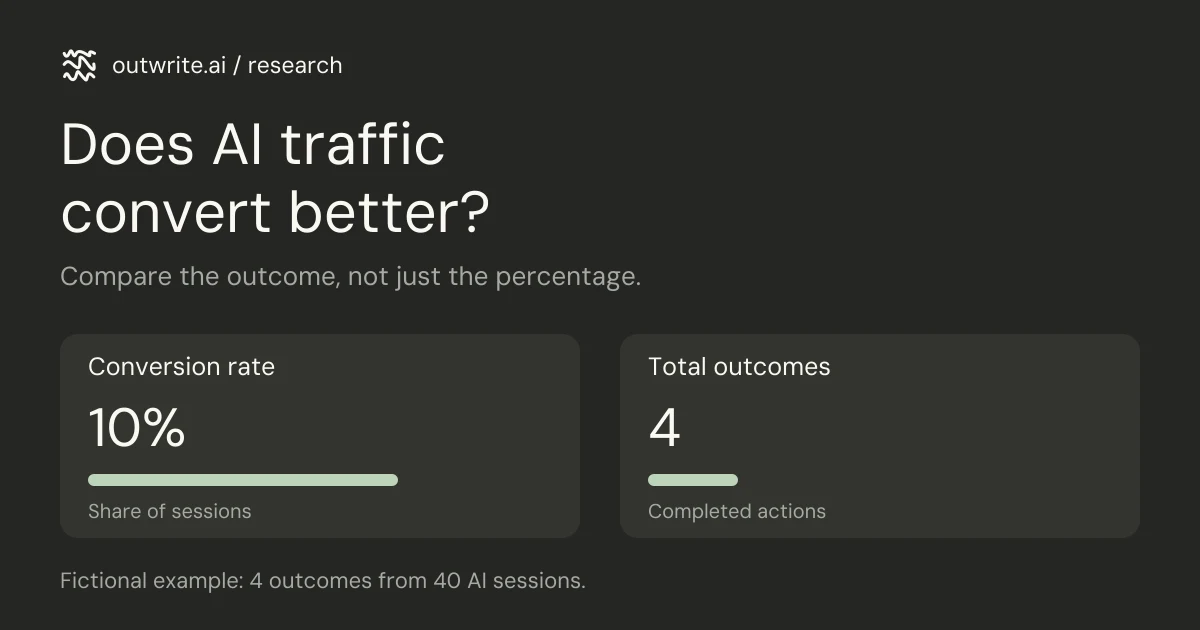
Consider a fictional company with the following results in one reporting period. These numbers illustrate arithmetic; they are not customer data or a performance target.
| Channel | Sessions | Sessions with the chosen outcome | Rate |
|---|---|---|---|
| AI assistants | 40 | 4 | 10% |
| Organic search | 1,000 | 30 | 3% |
The AI rate is higher, while organic search supplies more of the measured outcomes. A budget decision based only on the first fact would ignore most of the activity the business currently receives.
The small AI group is also sensitive to a single outcome. Three converting sessions out of forty would be 7.5%; five would be 12.5%. One outcome moves the rate by 2.5 percentage points. This is a sensitivity illustration, not a confidence interval or a test of statistical significance.
Suppose the owner improves a page and the next period records five AI outcomes. That is encouraging enough to investigate, but it does not prove the edit caused the change. The visitors may have asked different questions, arrived on another page, or already known the company. Keep the change log and look for a repeated pattern before treating the result as a reliable effect.
A useful report shows both the count and the rate. If you cannot explain the denominator in a sentence, postpone the channel ranking and fix the measurement first.
Why a headline multiplier does not transfer to your site
There are several decisions hidden inside a channel comparison. The source table makes some visible; a reader still needs to ask how the sample relates to their own business.
Start with the audience. Someone looking for an immediate purchase may behave differently from someone gathering ideas for a future project. A channel label alone does not describe that need. Compare the actual pages people reached and the offer they saw.
Look at how sites are combined. A pooled rate gives more influence to sites with more measured activity. A median of individual site rates describes the middle site. Neither is automatically wrong, but they answer different questions. Ask which summary is being quoted before applying it to a smaller operation.
Keep the period visible. A seasonal promotion, an outage or a new form can change a comparison. Review a complete period, then compare another complete period using the same definitions. If you change the source filter, record that separately from a change in visitor behavior.
Treat matching as a useful check, not a causal experiment. Comparing similar landing pages, markets and periods can reveal obvious mismatches. It cannot establish what those visitors would have done through a different route. You can make a sensible operational decision while leaving that uncertainty explicit.
For example, a business might decide to improve its pricing explanation because visitors from several sources struggle to find it. The improvement does not need an extravagant attribution claim to be worthwhile. Record the problem, the change and the subsequent evidence.
Google AI search is inside the organic comparison
Google Analytics defines an AI Assistant channel for supported assistant sources. It excludes Google's AI Overviews and AI Mode, which belong to Organic Search. 5 A chart comparing those channels is therefore not a clean separation of AI and non-AI discovery.
Search Console includes Google's AI features in its Web performance data. 8 That is useful context for search visibility, but those totals cannot isolate every AI answer click or demonstrate a purchase.
For a small team, the practical response is simple: keep the labels precise. Say “identified assistant referrals” when that is what you measured. Keep Google search performance alongside it. Avoid renaming a combined search total to make the report sound more comprehensive than the evidence allows.
This also changes how you read a missing result. No identified assistant sessions in one period is not proof that no customer encountered the business in an AI answer. It is a reason to state what the report can observe and keep the unknown portion unknown.
Missing attribution is a question to investigate
Google describes Direct / none as traffic without a clear referral source. Missing tracking information is one possible reason. 7 It is not a bucket that can safely be reassigned to whichever campaign you recently launched.
Our proposed process is to inspect the routes you control. Check that campaign links reach the right page and retain their tags. Compare source records before and after a known site change. Ask customers how they first heard about the business, while keeping their answers separate from automatically attributed sessions.
Self-reported discovery can add useful context. It is still a different measurement: someone may remember the source that introduced the company while analytics records the last identifiable visit. Preserve both records rather than forcing agreement.
Do not describe missing attribution as a hidden success. It may hide meaningful influence, or it may reflect unrelated activity. A useful report gives the owner the observed result and a specific next investigation.
A monthly record a small team can use
The following worksheet is our suggested operating method. It is not a tested attribution model or a guarantee that a particular amount of data is sufficient.
| Record | What to write down | Decision it supports |
|---|---|---|
| Period | Exact dates and comparison dates | Whether the periods are comparable |
| Source rules | Included domains or channel definitions, with a version date | Whether a classification change explains the movement |
| Sessions and outcomes | Both counts, plus the precise outcome definition | Whether a rate has a useful denominator |
| Event occurrences | Keep repeated events separate from converting sessions | Whether repeat actions inflate the headline |
| Landing pages | Pages receiving the visits and their intended next step | Which page deserves attention |
| Qualified outcomes | Confirmed suitable enquiries or customers, where you can verify them | Whether activity has business value |
| Known changes | New articles, price changes, forms, outages and promotions | What to investigate before attributing a change |
| Unknowns | Missing attribution, sparse observations or incomplete tracking | What the report cannot conclude |
Give the record an owner. If nobody is responsible for checking whether the enquiry form works, more elaborate charts will not fix the underlying measurement problem. Start by confirming that the event represents a completed action and that failed or repeated attempts are understood.
Review questions are often more useful than another score. Which pages attracted relevant visitors? Did those pages explain the offer clearly? Did the next step work on a phone? Did the enquiries match the customers the business can serve? Each question can produce a concrete task even when traffic is still limited.
Keep your visibility checks in a separate part of the report. A saved answer naming your company is evidence of a mention in that check. A citation is evidence of a linked source. Neither establishes that somebody visited or bought something. Connect the work through a shared question or page, not by assuming every mention became a customer.
How to act on the evidence
If identified AI traffic is small, continue recording it and investigate useful individual outcomes without presenting an unstable percentage as a forecast. If it grows, check whether the new visitors reach relevant pages and complete the action you intended. If the rate drops, examine changes in page mix and tracking before deciding the channel stopped working.
Keep improving the pages that help buyers across search routes. An accurate service explanation, a substantive comparison and an answer to a real buying question can have value beyond one assistant's current response. Do not abandon a productive search channel because a smaller one has a more exciting percentage.
outwrite.ai helps with that ongoing publishing work: it researches topics for your business, writes articles, publishes according to your settings and monitors supported AI answers. Connecting Search Console adds Google search evidence. Revenue attribution still requires appropriate analytics and verified business outcomes; the product does not turn a visibility score into proof of sales.
If the repeated research and writing are what keep getting postponed, try outwrite.ai free for seven days. No credit card is required. Use the trial to inspect the topics and workflow for your own website, then judge the work and its results with definitions you can explain.
Methodology & limitations
We inspected four primary reports and four official Google documentation pages on October 28, 2026. We compared populations, periods, denominators and reported outcomes, without pooling incompatible rates. Source notes retain missing methodological details. Our worked example and monthly worksheet are original editorial explanations, not an experiment or customer dataset.
outwrite.ai sells software for topic research, article writing, publishing and visibility monitoring. We did not conduct the third-party studies. The arithmetic example is fictional. This review does not establish causal revenue attribution or predict results for your website.
Download the source and evidence notes (JSON) ↓Sources
- [1]AI referral traffic benchmark ↗
The SEO Works · Undated dataset; checked October 28, 2026 · Checked 2026-10-28
Conversion comparison: 63 of 95 websites met thresholds of at least 100 AI sessions, 1,000 organic sessions and recorded organic conversions. GA4 events, not unique customers. Selected sites; Google AI search included in organic.
↑ Back to findings - [2]Does AI Search Traffic Convert Better Than Traditional Search? ↗
Ahrefs / Patrick Stox · June 16, 2025 · Checked 2026-10-28
Single vendor funnel; signup is not payment; no causal test.
↑ Back to findings - [3]GEO is a distraction ↗
Marie Haynes · October 21, 2026 · Checked 2026-10-28
Event definitions, industry mix and weighting not fully specified. Do not infer a representative business benchmark.
↑ Back to findings - [4]U.S. consumers are embracing LLMs to make travel plans ↗
Adobe / Vivek Pandya · August 19, 2026 · Checked 2026-10-28
Non-AI includes channels beyond organic search; selected observational cohorts, not randomized visitors.
↑ Back to findings - [5]Default channel group ↗
Google Analytics Help · Living documentation · Checked 2026-10-28
Rules and availability evolve; channel label does not measure all influence.
↑ Back to findings - [6]Traffic acquisition report ↗
Google Analytics Help · Living documentation · Checked 2026-10-28
Event count per session is not the same as the share of sessions converting.
↑ Back to findings - [7]Understand direct / none traffic ↗
Google Analytics Help · Living documentation · Checked 2026-10-28
Direct traffic cannot be reassigned to AI without supporting evidence.
↑ Back to findings - [8]AI features and your website ↗
Google Search Central · Living documentation · Checked 2026-10-28
Web totals do not isolate AI answer clicks or measure purchases.
↑ Back to findings
Report history
- : First publication. Primary sources and metric definitions checked; fictional arithmetic labeled.