In this report
What we found
- Google says AI Overviews and AI Mode may expand searches across subtopics. Its announcement explains AI Mode, not a complete query-log interface. [1][2]
- Documented API search fields and final citations describe different parts of an answer. Their scope must stay attached to the data. [3][4]
- Ahrefs corrected a claim about searches to a narrower claim about responses containing fan-out queries. [5]
What this is and is not
Query fan-out describes expanding a question into related searches. The useful editorial question is which parts of a buyer's decision your page leaves unanswered. An inferred list of subquestions can help with that task, provided you label it as a proposal rather than a recovered search log.
This review examines seven sources and offers a practical briefing method. It includes one hypothetical example, an evidence checklist for choosing tools, and a measurement plan. We have not tested the method for citation or traffic gains. We make no claim that outwrite.ai captures hidden fan-out queries. You can use the method with a spreadsheet.
A source-status framework
The core problem is that four different kinds of statement get blended in industry writing. We suggest labeling each one before it enters a brief.
| Status | What it is | Examples in this review | What you may say |
|---|---|---|---|
| Platform-documented | The operator describes its own behavior | 1, 2 | The system may do this, in this product |
| Documented interface | A developer field exposes searches or sources | 3, 4 | These fields exist in this API |
| Vendor measurement | A company's observational sample | 5 | In this sample, this was reported |
| Editorial hypothesis | Our reasoning about what to write | Sections below | We propose, untested |
Observation versus inference. Documentation of a mechanism is an observation about what the operator says. Concluding that your page will be cited because it answers likely subtopics is an inference no inspected source establishes.
What the documents establish
Google says AI Overviews and AI Mode may issue related searches across subtopics and data sources. Its documentation keeps ordinary SEO requirements in place. 1 The May 2025 AI Mode announcement explains decomposition and simultaneous searches; it is a historical explanation, not a fixed query-count promise. 2
OpenAI documents that API search actions usually, but not always, include the queries searched. Its consulted-source list can be broader than its inline citations. 3 Perplexity's Agent API quickstart separately illustrates query/result records and cited answer output. 4 These are specific developer interfaces, not universal records of consumer sessions.
In its October 12, 2026 report, Ahrefs describes 66.6 million free, logged-out GPT-5.6 Luna responses from August and September. It reports that 14.4% contained fan-out queries. An October correction explicitly narrows the earlier wording that this share searched the web. This is a vendor observational sample, not a test of how editing pages affects citations; it does not establish that the remaining responses performed no search. 5
Where sources appear to disagree, and why
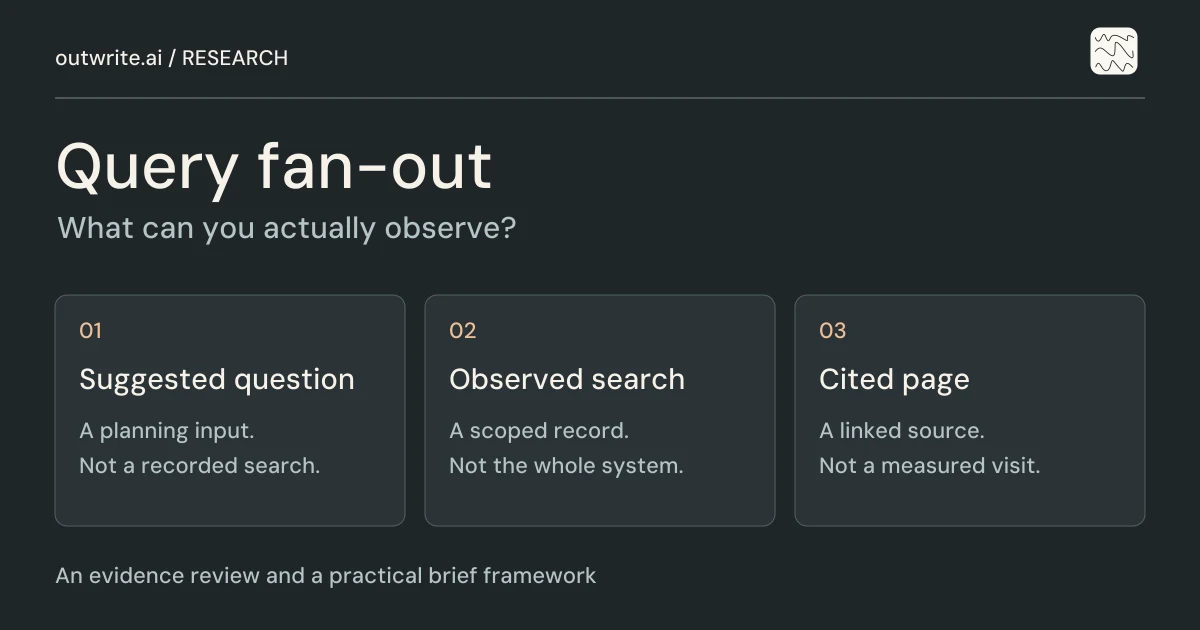
A list of possible searches, a returned query field, a source URL and a final citation answer different questions. Our interpretation is to preserve those distinctions through the entire editorial process.
| Record you have | Safe conclusion | Conclusion to avoid |
|---|---|---|
| A model-generated question list | These are proposed questions to investigate | These are the exact searches a platform ran |
| A returned query record | This interface exposed this query for this run | Every buyer sees the same searches |
| A consulted URL | The tool reports consulting this source | The source appeared in the final answer |
| A linked citation | This response cited this URL | The citation caused a visit or sale |
| No returned query metadata | Query details are unavailable in this record | The system did no searching |
This is our proposed interpretation guide. It should travel with an export or screenshot so that a later reader does not mistake a planning suggestion for an observed event.
Before accepting a coverage score
Ask what the denominator represents. If your team generated a list of ten plausible questions and answered six, you have covered six of your own ten suggestions. That may be useful for editing. It is not a measurement of the share of a platform's internal searches you satisfy. The numbers here are illustrative, not observed results.
Keep the original list and the reasons for selecting it. Otherwise, adding easy questions or removing hard ones could improve the displayed score while leaving the article unchanged. Our recommendation is to review the unresolved reader decisions directly. A score should never substitute for reading the missing answers.
A second question is whether the list belongs to this page. A pricing objection, an implementation procedure and an introductory definition might all relate to the product but serve different readers. Combining them automatically could make the article less useful for the person who arrived with a specific task.
Editorial proposal: inclusion decisions for a brief
Editorial proposal, untested. Treat inferred subquestions as editorial candidates, never as discovered queries. Name them "related subquestions," not "the fan-out." Each candidate gets one of four decisions.
| Decision | Definition | Proof needed | Page placement |
|---|---|---|---|
| Include | A buyer needs it to complete the main task | Relevant customer questions, public search evidence or documented editorial reasoning | Section in the main article |
| Link out | The reader task genuinely differs and deserves depth | Distinct task, distinct evidence, standalone usefulness | Separate page, linked from the article |
| Defer | Plausible but unsupported | Missing proof, such as a comparison we cannot substantiate | Backlog, with the missing proof noted |
| Reject | Not relevant to this reader's task | Fails the task test | Not written |
Stop rules. Stop adding material when it no longer changes the reader's decision. Do not create another URL merely to repeat an existing answer with different wording. Defer claims that need evidence you do not have. These are editorial rules we propose, not a citation formula. Google's helpful-content guidance emphasizes audience value and states no preferred word count. Its spam policies address manipulative scale and doorway pages; a separate useful page is not automatically a violation. 6 7
Worked hypothetical: moving from spreadsheets
Imagine a small accounting software vendor writing a guide for finance managers at small firms moving off spreadsheets. This is invented for illustration. It gives no tax, legal or financial advice.
Main article: "Moving your bookkeeping from spreadsheets to accounting software." The buyer's task: decide whether to move and plan the move without losing records.
| Candidate subquestion | Decision | Reason and proof needed | Placement |
|---|---|---|---|
| What should we audit in our spreadsheets before moving? | Include | Reader cannot plan without it; seek the vendor's documented onboarding procedure | Main article, early |
| How do we map accounts and categories? | Include | Core migration step; demonstrate with a sanitized sample sheet | Main article |
| How do we run both systems in parallel for a period? | Include | Potential concern; verify the vendor's tested procedure | Main article |
| What do we do about historical data and who keeps access? | Include | Tell readers to confirm record-keeping duties with their advisor | Main article |
| Step-by-step import for each file format | Link out | Different task, hands-on, deserves its own tested walkthrough | Separate page, linked |
| History of spreadsheet software | Reject | Irrelevant to the buyer's decision, and no task is served | Not written |
| Is our product faster than a named competitor? | Defer | We have no tested, reproducible comparison; publishing it would be an unsupported claim | Backlog until we can test and document method |
The rejected item fails the task test. The deferred item is not necessarily wrong, it is unsupported. Marking it deferred keeps the article honest.
Result: one coherent article with perhaps four or five related sections, plus one separate how-to page where the task truly differs. We do not make a page for each inferred query, because this brief assigns work by the reader's task.
Before commissioning the article, the editor would ask the hypothetical vendor to supply its import documentation and a sample file with invented records. If those materials do not exist, the writer should not manufacture a successful migration story. The brief can explain what to check while leaving unsupported product-specific steps out.
The reviewer then follows the sample procedure and checks whether the article describes the same fields, file type and result. A screenshot belongs in the piece only if it shows the actual documented procedure and contains no customer records. This gives the team an acceptance test independent of whether an assistant happens to cite the finished page.
Procurement questions for tools claiming fan-out data
Request one example export before buying a fan-out analysis tool. Ask the supplier to show where each field came from, including the original prompt, the surface used, the collection time and the returned queries where available. A polished topic map alone cannot answer that question.
- Origin: Were the strings returned by an interface, extracted from an observed session, or generated by a model as suggestions?
- Scope: Which assistant and interface were sampled? Were sessions logged in? Was the collection designed to represent your audience?
- Missing records: Does an empty field mean unavailable, unsupported, or a confirmed zero?
- Reproducibility: Can you inspect a saved response without paying to run the same request again?
- Meaning: Are consulted URLs, cited URLs and brand mentions recorded separately?
- Effect: Does the supplier distinguish a coverage suggestion from evidence that an edit caused a change?
Our proposed acceptance rule is simple: reject an unexplained metric until its source and denominator are clear. You may still buy a useful planning tool that generates hypotheses. The issue is whether the product describes what it actually measures.
For a small team, a limited sample relevant to a real buying decision can be a better starting point than a broad report whose collection method nobody can explain. That is a purchasing judgment, not a measured comparison of vendors.
Editorial proposal: a measurement protocol
This is a proposed protocol, not an experiment we have run. First, save the article version, the brief and the date of publication. State the change precisely: for example, adding a checked import example to answer a previously unsupported implementation question. Record other changes made at the same time.
Choose a small set of relevant questions before collecting follow-up observations. Save the exact prompts, product, interface, available model label, language, region and date. Keep failures and missing responses in the log. Do not quietly replace an unfavorable prompt with one that mentions your brand.
Separate outcomes in the record: a brand mention, a citation to the article, a citation to another page, and an actual measured site visit. Use a denominator that matches the outcome being discussed. A reader should be able to tell whether a proportion describes completed sampled answers or another population.
Review page traffic separately. Google includes AI-feature traffic in Search Console's Web reporting. 1 That aggregate does not isolate a fan-out effect. Site visits and attributable conversions need their own measurement; neither follows automatically from a citation.
Our suggested first review asks whether readers can now complete the intended task. Subsequent reviews can examine relevant search queries and repeated answer samples with the same protocol. Keep the previous version available so an editor can judge what changed.
If citations rise, record the observation and the competing explanations. A before-and-after comparison can coincide with model changes, shifting demand, changes elsewhere on the site or a different sample. If citations stay flat, do not assume the useful correction failed: the immediate outcome may have been a more accurate page. Neither result establishes causation on its own.
Limits of this review
The sources comprise three Search Central guidance pages, a Google product announcement, two developer documentation pages and one vendor study. They establish narrower facts about documentation, interfaces and a reported sample. They do not test our proposed briefing method or establish a universal way to recover hidden searches.
We selected these sources for the decisions covered here, not as a systematic review of every paper or tool. Product documentation can change, and the vendor sample is not representative of every assistant, user or market. The hypothetical example is an editing exercise, not a customer case study. The practical standard is to make each claim and inclusion decision inspectable before treating it as a reason to publish. This is not a causal test or experiment. Google and other documentation can change after our inspection date.
Methodology & limitations
Seven primary sources were inspected on November 8, 2026. Documentation, a historical announcement and one vendor observational study are distinguished in the source notes. Unverified discovery leads were excluded. Editorial proposals are not evidence of citation lift. No customer data or private query logs were used.
outwrite.ai publishes this research review and sells content and search-visibility software. The proposed workflow and hypothetical example are original editorial analysis, not tested performance claims. We did not run the cited vendor study or a new optimization experiment.
Download the source and evidence notes (JSON) ↓Sources
- [1]AI features and your website ↗
Google Search Central · Publication date not stated · Checked 2026-11-08
Google-specific guidance, not a complete query log.
↑ Back to findings - [2]AI in Search: Going beyond information to intelligence ↗
Google · 2025-05-20 · Checked 2026-11-08
No fixed query count or current rollout claim.
↑ Back to findings - [3]Web search ↗
OpenAI · Publication date not stated · Checked 2026-11-08
Queries are not always returned; consumer sessions may differ.
↑ Back to findings - [4]Agent API ↗
Perplexity · Publication date not stated · Checked 2026-11-08
Developer examples, not consumer measurements.
↑ Back to findings - [5]How ChatGPT Does Query Fan-Out (15 Million Queries Studied) ↗
Ahrefs · 2026-10-12 · Checked 2026-11-08
Vendor sample, not universal search frequency or causal evidence.
↑ Back to findings - [6]Creating helpful, reliable, people-first content ↗
Google Search Central · Publication date not stated · Checked 2026-11-08
No citation formula established.
↑ Back to findings - [7]Spam policies for Google web search ↗
Google Search Central · Publication date not stated · Checked 2026-11-08
Separate useful pages are not automatically violations.
↑ Back to findings
Report history
- : Published an evidence review and a proposed editorial briefing method.