In this report
What we found
What justifies a content refresh?
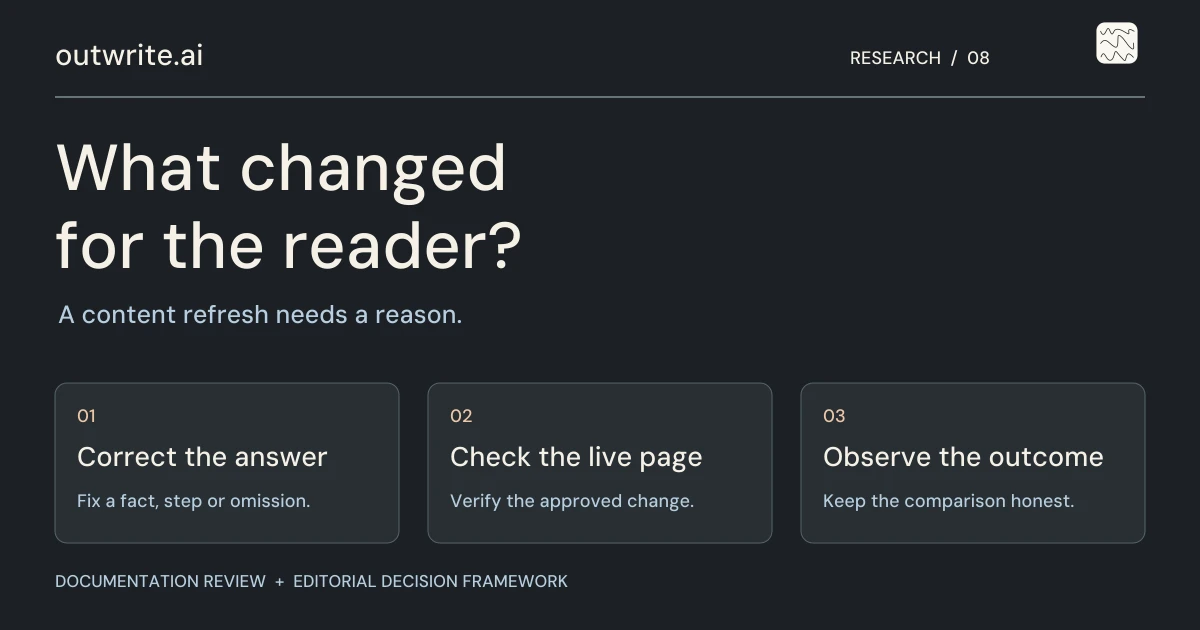
A useful content refresh has a specific correction to make. An old comparison may quote the wrong price. A tutorial may direct readers to a setting that moved. A guide may leave its central question unanswered. Each gives an editor something to inspect and a way to judge the finished work before search traffic changes.
We would not commission a rewrite solely because an article has an old date. Google describes freshness systems for queries where newer information is expected. It separately identifies changing dates on substantially unchanged pages as a warning sign of search-engine-first work. Neither document supplies a universal interval for rewriting a library. 1 2
This review examines nine primary documentation pages and proposes an editorial decision process. It is not a ranking experiment. The examples below are hypothetical, and the suggested workflow has not been tested for a traffic or citation lift. Its immediate purpose is narrower: help a small team approve useful work and decline unnecessary edits.
What the official guidance establishes
Google's traffic-drop guidance describes several possible causes, including technical faults, changes in demand and ranking changes. It recommends comparisons across similar periods and relevant segments, and cautions against radical edits after small position fluctuations. It says effects of changes can take days to months. That supports investigation before assigning a rewrite; it does not diagnose a particular page. 4
Two reporting details can change that investigation. Search Console omits anonymized queries from its query table, so an absent row does not establish zero demand. Most performance data is credited to the canonical URL, which may differ from the address an editor is checking. 5 6
Google's current generative-search guide emphasizes useful original material and ordinary SEO. It does not prescribe a special writing style, ideal page length or special schema for those features. Meeting its requirements still does not guarantee indexing or display. These are Google-specific statements, not evidence about every assistant. 9
Our interpretation is that an editorial brief should name the reader problem separately from the hoped-for search result. “Replace the obsolete setup steps” can be verified on release. “Get recommended more often” needs its own observations and may remain unresolved even after a sound correction.
A decision table for the editorial queue
The following is our proposed triage tool. Each row describes an example, not a measured outcome or an exhaustive list of SEO problems.
| What you find | First action | What would justify closing the ticket? |
|---|---|---|
| An obsolete price in a comparison | Check the vendor's current offer and the scope of the quoted plan | The table, prose and conclusion agree with the checked offer |
| A setup guide missing a required step | Follow the documented procedure in an appropriate test account | A reader can complete the intended task with the revised instructions |
| A public article accidentally marked noindex | Send the observed directive to the site owner | The owner verifies the intended directive on the deployed page |
| Fewer visits, but no identified reader problem | Investigate the affected queries and periods | A documented decision to investigate further, edit, or leave unchanged |
| A correct article with only an old date | Check the time-sensitive claims | A review note explaining why no public edit is needed |
Treat the first three as different jobs. An editor can correct a price, but a noindex directive may come from a shared template. A rewritten introduction would leave that technical problem untouched. Conversely, a healthy template cannot repair a comparison that recommends a plan on the basis of a feature it no longer includes.
Give the person accepting the work the original problem statement. Without it, a reviewer can approve polished prose while missing the reason the article entered the queue.
Worked example: a comparison with an obsolete price
Imagine a small software consultancy has a guide comparing two scheduling products. The article includes a monthly price, a feature table and a recommendation for teams that need shared calendars. The editor discovers that one product moved shared calendars into a different plan. This is an invented case; no particular vendor or customer result is implied.
The immediate task is to check both the price and the recommendation. Merely replacing the amount in the table could leave the conclusion misleading. The reviewer should identify the plan that now supplies the required feature, note whether the displayed price assumes annual billing, and check any seat minimum before rewriting the relevant comparison. Keep the original source URL and the date checked in the work order.
Next, inspect where that fact appears. It might be in the opening answer, the table, a screenshot and the final recommendation. Mark each occurrence and decide which needs changing. If a screenshot shows an obsolete offer, replace it with an appropriate current capture or remove it rather than leaving conflicting information on the page.
Preserve the parts that remain useful. If the explanation of connecting a calendar is still correct, a full rewrite could add review work without solving another problem. The brief should explicitly say which sections need rechecking and which are outside this edit.
Acceptance is concrete: a second reader can follow the recommendation back to the checked offer, identify the billing assumptions and understand the tradeoff. The article may still gain or lose traffic afterward. Either outcome is separate from whether the obsolete recommendation was repaired.
Worked example: a tutorial that may need no rewrite
Now imagine a gardening business reviewing a guide to cleaning reusable seed trays. Visits have fallen after its busiest season. The editor suspects the page is too old, but has not found an inaccurate instruction. Again, this is a hypothetical case, not evidence about gardening searches.
Our proposed first step is to inspect the actual page and the comparison being used. Does the recent period cover different seasonal demand? Are the same country and device segments being compared? Did the page address or canonical change? Has the business changed the title, navigation or distribution during the observation window? Write down unresolved questions instead of converting each one into an editorial task.
Suppose the procedure remains accurate, the article still answers its stated question and the historical pattern is consistent with the same seasonal decline. That is a reasonable basis for leaving the text alone while continuing observation. It is not proof that seasonality explains every lost visit. A new reader complaint or an identified factual error would reopen the decision.
Keep a private review record: who checked the instructions, which information was checked, what remained uncertain and what would trigger another review. A review date in an internal spreadsheet need not become a new publication date on the article. This gives an agency a useful answer when a client asks what work was done, even when the correct decision was to avoid rewriting a sound page.
A small work order that protects the facts
Here is the work order we would use for either example. It is an editorial proposal, not a search-provider requirement.
- Reader task: Write what the visitor should be able to decide or do after reading.
- Observed problem: Save the exact passage, broken step or technical symptom. Attach the evidence that makes it a problem.
- Proposed change: Name the smallest useful repair and any related passages that must stay consistent.
- Facts to preserve: List qualifications, dates, units, geographic limits and product-plan assumptions that a rewrite must retain.
- Acceptance check: Assign a reviewer and describe what they will inspect. “Looks better” is too vague for an outdated procedure.
- Measurement question: Record the separate search outcome you want to observe, the comparison window and the other changes that could affect it.
For assisted writing, give the tool the same bounded task. A useful request might be: “Update this comparison using these checked offers. Keep the audience and decision criteria. Flag anything the evidence does not establish.” Review the result against the source record, especially if a fluent rewrite removes a condition such as “on annual billing.”
If evidence remains missing, narrow the passage or keep the work in review. Filling that gap with a plausible number would defeat the purpose of the refresh.
Publication dates and discovery checks
Google recommends agreement between visible and structured dates, describing the page's publication or modification rather than the event being discussed. It uses multiple signals and does not guarantee a displayed byline date. 3
Its sitemap guidance says lastmod should describe the last significant update; a changed copyright year does not qualify. Sitemap submission remains a hint without a crawling guarantee. IndexNow similarly notifies participating engines about changed URLs, but each engine decides whether to crawl and index. 7 8
For our proposed release check, keep the existing article address unless a separate migration is necessary. Open the public page after publishing and compare it with the approved version. Check the changed paragraph, table, images and source links. Confirm that a cached page is not still showing the old recommendation. Ask the site owner to inspect any relevant date fields and discovery configuration.
Record “published and checked” only after that inspection. A successful notification request belongs in a separate field from an observed crawl, indexed page or citation. That distinction makes a stalled handoff easier to diagnose without commissioning another rewrite.
How to evaluate the work afterward
Choose an observation plan before editing. For a modest editorial program, we would record a complete baseline window, the changed URLs and the date each approved revision became public. Select comparison periods that make sense for the topic, allowing for seasonality and reporting delay. Adjacent periods can be useful, but a year-over-year comparison may answer a different question.
Keep the same page and query definitions when comparing results. Record title changes, site migrations, promotions and other substantial edits during the window. Our editorial reasoning is that if the chosen pages were already falling sharply, a later rebound deserves particular caution: the selection process itself makes a simple before-and-after result hard to interpret.
For AI-answer observations, save the actual question, collection date, platform and cited URL. Decide in advance whether you care about a citation to the repaired guide, a mention of the company or an explicit recommendation. Keep an unavailable response separate from a usable answer with no mention. If the observation method changes, document the break rather than presenting one continuous series as directly comparable.
At review time, answer two questions separately. Did the release fix the documented reader problem? What, if anything, changed in the chosen search observations? A correct price can make the first answer yes while the second remains uncertain. That is an honest outcome, and it identifies what to investigate next without inventing a causal traffic gain.
Methodology & limitations
Documentation review of nine primary pages inspected on November 5, 2026. Three Sonar Pro discovery requests supplied research leads; one truncated output was excluded. Claims were checked directly against the primary pages. Sonnet synthesis was edited, humanized and separately reviewed. The decision table, work order and examples are our proposed editorial interpretation; no ranking or citation experiment was run.
Published by outwrite.ai, a content and search-visibility software provider. No traffic uplift, customer result or tested effectiveness is claimed for this proposed workflow.
Download the source and evidence notes (JSON) ↓Sources
- [1]Google Search ranking systems ↗
Google · Current documentation · Checked 2026-11-05
Describes a system, not a measured uplift or universal refresh interval.
↑ Back to findings - [2]Creating helpful, reliable, people-first content ↗
Google · Current documentation · Checked 2026-11-05
No numeric penalty or guaranteed result from a substantial refresh is specified.
↑ Back to findings - [3]Influence your byline dates ↗
Google · Current documentation · Checked 2026-11-05
Date display does not establish a ranking benefit.
↑ Back to findings - [4]Debugging drops in Google Search traffic ↗
Google · Current documentation · Checked 2026-11-05
No single chart pattern diagnoses an individual page or proves a refresh caused a change.
↑ Back to findings - [5]Performance report: data discrepancies ↗
Google · Current documentation · Checked 2026-11-05
A missing query is not evidence of no demand.
↑ Back to findings - [6]Performance report: dimensions and data groupings ↗
Google · Current documentation · Checked 2026-11-05
Inspect the correct URL before interpreting absence from a report.
↑ Back to findings - [7]Build and submit a sitemap ↗
Google · Current documentation · Checked 2026-11-05
A sitemap is neither an editorial quality evaluation nor evidence of indexing.
↑ Back to findings - [8]IndexNow FAQ ↗
IndexNow · Current documentation · Checked 2026-11-05
Applies to participating engines. Does not demonstrate Google adoption, ranking lift or AI citations.
↑ Back to findings - [9]Optimizing your website for generative AI features on Google Search ↗
Google · Current documentation · Checked 2026-11-05
Google-specific guidance; it does not describe other assistants. The reporting features referenced in its current guide were not verified in an account.
↑ Back to findings
Report history
- : First publication: primary-source review and proposed editorial decision framework.